

While some European countries are just trying to understand, how to regulate new digital formats, Malta is already betting on the next stage of industry development. Prediction markets came into focus - segment, which is somewhere between financial instruments, blockchain technologies and gambling. At the same time, Ukraine is discussing an almost opposite initiative: restriction of esoteric services, fortune telling and commercial practices, associated with magic and the occult.
It makes for an interesting contrast. Some talk about legalizing forecasts for events and creating a new industry, others - about prohibitions in the field of predictions and mystical services.
in spring 2026 Maltese authorities began actively discussing the creation of a separate legal framework for prediction markets. Economy Minister Silvio Schembri said, that the country is exploring a fast-growing segment and viewing it as a source of innovation. The main emphasis is on transparency, user trust, compliance and clear rules of the game.
In parallel, Prime Minister Robert Abela included the topic in a broader package of initiatives. Among the ideas is expanding the powers of the regulator Malta Gaming Authority, investments in digital areas, eSports development, tax incentives for companies, working with AI and automation, as well as a simplified business model for international entrepreneurs.
For Malta, this looks like a logical continuation of the previous strategy. Previously, the country has already tried to take positions in the blockchain and crypto industry, a similar approach is now being applied to prediction markets.
But almost simultaneously, an initiative of a completely different nature appeared in Ukraine.. People's Deputy Georgiy Mazurashu registered bill No. 15251, which proposes to limit activities, related to fortune telling, esotericism, extrasensory perception, magical and occult services.
The document provides for responsibility not only for the provision of paid services, but also for advertising, promotion and dissemination of information about them. Consultations may be subject to potential regulation, pages on social networks, advertising integrations, thematic courses and part of the information business, built around similar practices.
Interesting, that both stories are united by one theme - working with predictions of the future. But states approach this in completely different ways..
In the case of Malta, we are talking about a technological model: users make predictions about political events, economy, elections, sports or social processes through digital platforms. This is seen as a promising market segment.
In the Ukrainian debate, the emphasis has shifted towards consumer protection and the fight against commercial practices, which can exploit the audience's gullibility, especially when guaranteed results are promised, “magical help” or solution to life problems.
It is important to separate the two processes. The Malta initiative still remains a political course and election rhetoric, and the Ukrainian bill is only the initial stage of the legislative path. Neither direction has yet become the final norm..
What could this mean for Ukraine?
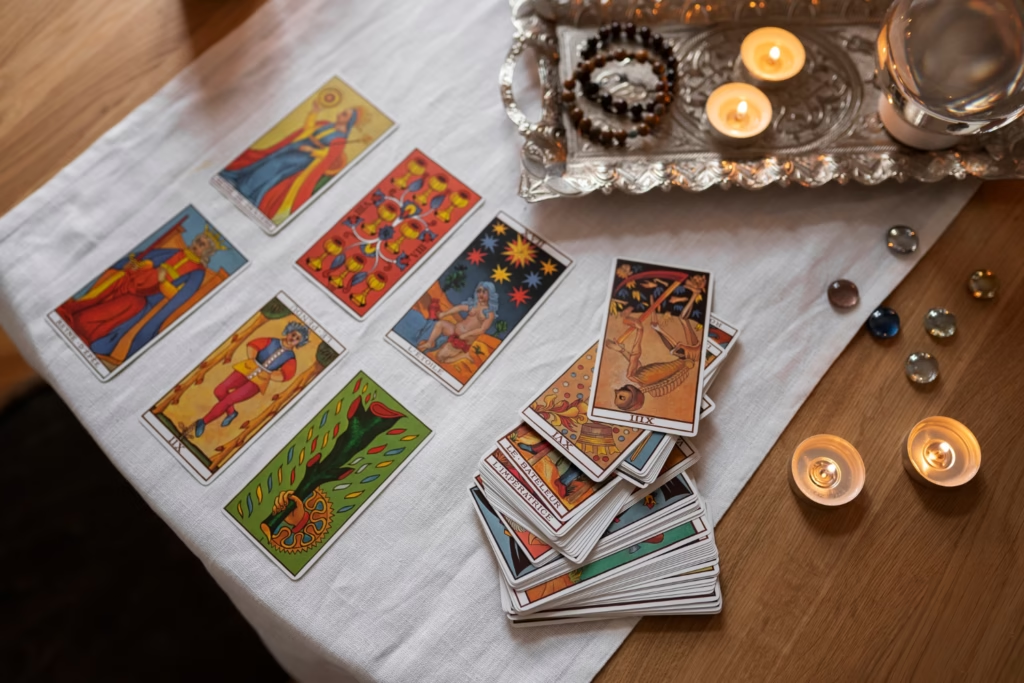
If the bill receives support, Ukraine may become one of the few countries in the region, where the market for esoteric services will come under separate regulation or restrictions. This will affect not only offline services, but also the digital space: advertising, bloggers, paid consultations and thematic media.
Against this background, the difference with Malta is especially noticeable. While the island state is trying to become a hub for new digital segments - blockchain, AI, eSports and prediction markets - Ukraine is betting on increased control and protective mechanisms.
In fact, countries are going down two different paths. Malta is looking for growth points in new niches, Ukraine is trying to determine the boundaries of that, what should generally remain part of the legal market.